
OR, A BIT OF JUNGLE AND ATMOSPHERE AFTER THE NEWLY RUINED YUCATAN.
I’m not going to bang on today about the shit stuff that I experienced wandering around Mexico at the end of last year, oh I’m not a whiner, you know me better than that. Yesterday is yesterday, fair does.
Becán

While researching this I came across Román Piña Chan, a very famous archaeologist, a tragic afterthought in Mexican research history, specifically that of Becan where he had the accident on that ill fated day. I wanted to include him as he sounded a dear, meek man who suffered hugely for his passion. Bedbound for seventeen years after the spirits of Becan let him fall to his fate.
Below is his small obituary, as modest it would seem as he was, and although translated quirkily I feel fitting for the man who it seems also discovered the Olmec figures and contributed hugely to the field
✔ Posthumous tribute to the archaeologist in the National Museum of Anthropology
Piña Chan was a generous being and always needed know yourself loved and accepted, says Beatriz Barba
ത Locate the recent find in Becán, Campeche, as part of his legacy
JIMENEZ ARTURE
 In 1984, Román Piña Chan fell from a pyramid from the archaeological zone of Becán, an accident that although not managed to remove him from the investigation, the reflection and teaching did limit their ability to move.
Becán marked the specialist, but himself time, with his work, Piña Chan also left his footprint in that pre-Hispanic site of Campeche, his home state. Maybe the most important Mexican archaeologist of the last years, Piña Chan died on April 10, three months ago, at 81 years old.
Last Wednesday afternoon, the day before of the emotional tribute to the researcher, yesterday at the National Museum of Anthropology, archeologist Lucia Campaña discovered a grave pre-Hispanic in building number 9 in Becán. Is as if Piña Chan were present, said Sara Bermúdez, president of the National Council for Culture and the Arts. They were Bermúdez and Sergio Raúl Arroyo, director of the National Institute of Anthropology e History, as well as Campecho authorities, who led yesterday morning the national tribute paid throughout the day Piña Chan.
” I learned about him as you know about legendary characters. His fame as a sage, as an active and generous man was not secret, “said Arroyo, and then mentioned fundamental books like Mesoamerica. Historical-cultural essay or The jaguar people.
Knowledge producer
Beyond the official voices they were his wife, Beatriz Barba de Piña Chan, and several family, friends, colleagues, students and admirers of his work. From the first two tables emerged anecdotes, references to his many books and tight comments of his field investigations through almost all archaeological zones important in the country.
Nights of fearsome brandy in San Cristóbal of the houses or gin enclosures due to tropical storms in the island of Carmen, were shared by Carlos Navarrete, anthropologist and friend of Piña Chan. The attraction to the sea that the archaeologist felt was remembered by ethnologist Roberto Williams, who defined him as a “knowledge producer”.
In the long presidium of the Jaime Torres auditorium Bodet of the National Museum of Anthropology were Arturo Romano Pacheco, Jaime Litvak, Angel Iván Rivera Guzmán, Arturo Oliveros, Lorenzo Ochoa, who spoke about various aspects of the work of Piña Chan:
Preclassic cultures, those of Oaxaca, those of north, those of the west, those of the Gulf of Mexico, those of the Altiplano. Ochoa gave an example of Piña Chan’s simplicity when he mentioned his little-spread discovery of Olmec figures 68 and 63, in La Sale.
‘ ‘I owe make it clear that Piña Chan was a person of few words as soon as to social formulas “, his wife would trust the audience last night, Beatriz Barba, researcher emeritus at INAH. And added: ” He was a shy man and therefore the expression of his feelings was sparing and sometimes cutting, but instead he was very generous, understanding and excellent friend, and always needed to know yourself dear and accepted.
” He chose to die on April 10 because it was Zapatista at heart, after almost 17 years of being reduced to an exasperating space as a consequence of the work accident who suffered in Becán.
” I saw him get depressed at first to such a degree that we feared for his life, but for the multiple manifestations of friendship that all of you did to him, little by little he found a new path and rate of production, which consolidated and allowed be active; for all this I am, again, very grateful. “
Another and the same tribute to Piña Chan will be held next July 19 in the city of Campeche, at the Teatro Francisco by Paula Toro, from 10 in the morning and throughout the day until dusk.
Just had a quick poke about and indeed he has a little museum North of Mexico city in Teotenango that you might like a glance at if you’re keen on unsung heroes as I am. Archaeological Museum of Teotenango.
The visit to the site of Becan.
Anyhoo. From my tiny cabin I stumbled out on my first day in Xpujil. I tried to organise a cab to take me to the nearby and frankly easier site than Calakmul (I’ll moan about that in days to come he he) It was at the end of a frustrating dust covered morning of finding the complications that had been added to a previously simple process of going to the now frankly rather over-rated Calakmul. Oh you mean old bird I hear you cry, but I’m not.

Finally I found no local cab but a bus that served me very well bar a short walk from the main road and I was in for a treat as Becan is an impressive place. I don’t know how I missed it last time as it’s truly beautiful and with few tourists and fuss. So from the sign there:

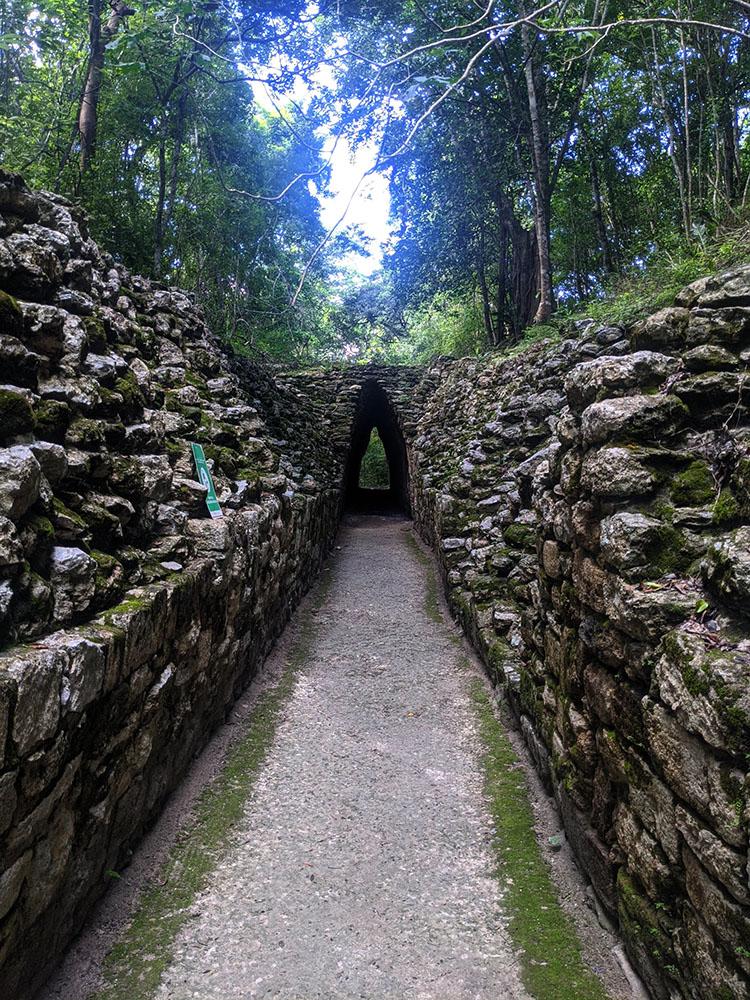
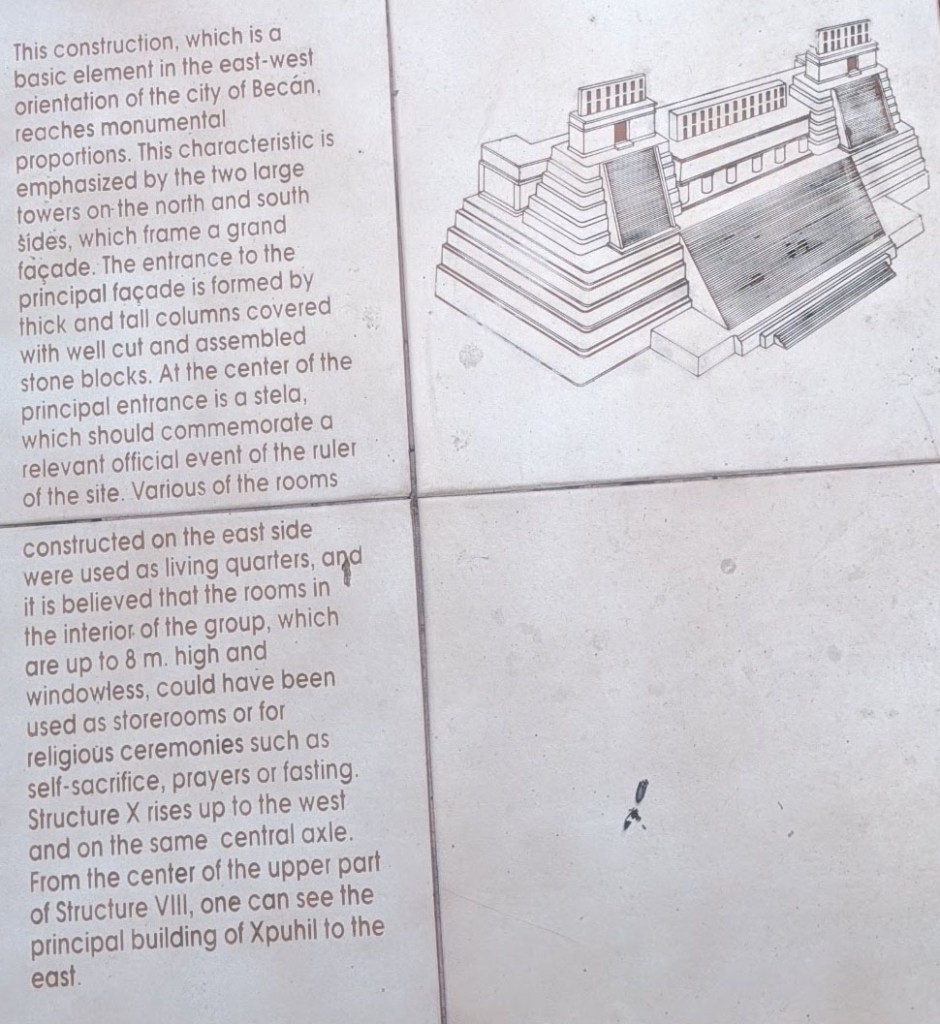
“The name Becán, which in Yucatec Mayameans trench, is precisely named for one, which protects the most important buildings. This trench, 5m. deep, 16 m. wide and with an interior parapet, has a perimeter of almost two kilometers and encompasses 12 hectares. The access to the zone is restricted to seven entrances, each with its own bridge. Presently, one can visit 20 major constructions associa ted with plazas and patios, distributed over three hectares. Outside the protected area, however, numerous platforms, foundations and remains of simple houses belonging to the ancient population have been recorded. Becan was the political, economic and religious capital of the province known today as Rio Bec, to which the sites of Xpuhil Chicanná, Puerto Rico, Okolnuifz, Channa and Ramonal belong. ’tis strategically located at the base of the Yucatán Peninsula, on the route which unites the river and lagoon zone of southwestern Campeche with the territories of Chetumal Bav. The sites in the Petén Region are found to the south of Becái and to the north, the Chenes (wells) settlements in northeastern Campeche, with whom it also maintained relations. The earliest archaeological evidence from Becán dates from 550 B.C., period in which the Olmec culture was declining at sites such as La Venta, Tabasco. The apogee at Becán, reflected in the construction peak and the population density took place between 600 and 800 A.D. At this time, Cholula recovered importance, while Tajin reached its splendour. Becán was abandoned around 1200 A.D. when Tula and Mitla were in their period of florescence.”
Well there you have it, known for its ditch which they still don’t know what service it was meant for. The usual squabbles ensue with the historians, I wonder what our friend Piña Chan would have said?
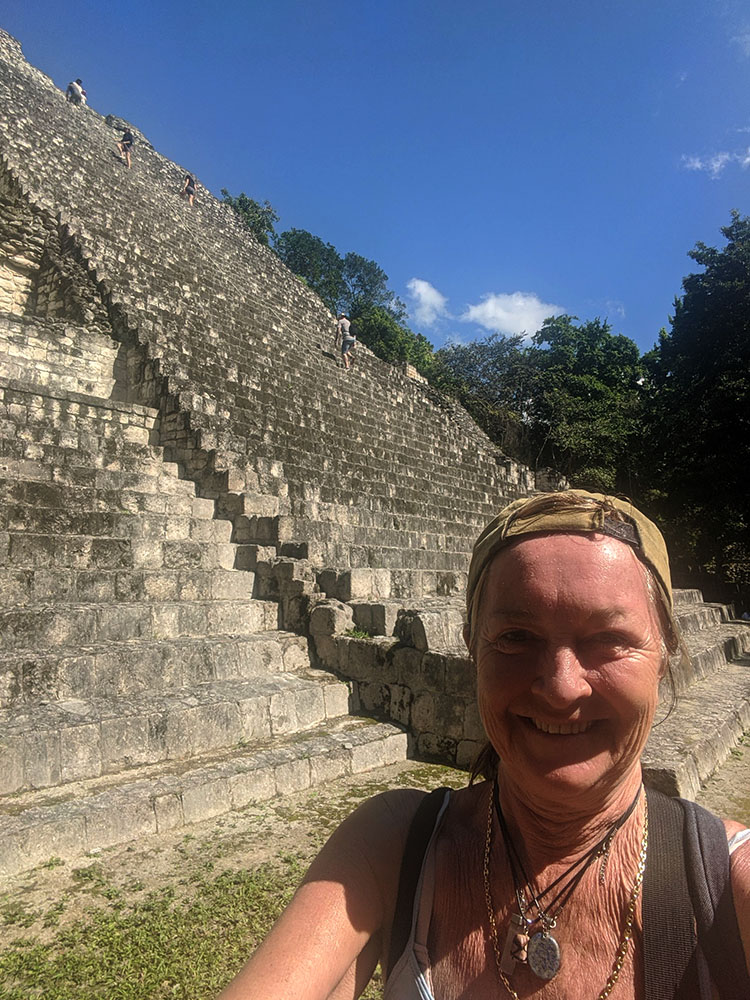
As sites go I think it was magical there and somehow retained an air of mystery and grandeur in its stones. These days I prefer to go on the vibe of the site rather than try to analyse the ‘Structures’. If you don’t go in with that attitude the piles of stones start to feel tediously similar. As one sad tourist said to me in Egypt he was “all templed out” An idea of the highlights of the site is handy but apart from that you really should just try to enjoy the entirety and also please stop with the whining about climbing every fucking pyramid, the views are all pretty much the same at the top. This fervent preoccupation is getting very tired and is very dangerous when people start to get flash. Just enjoy and absorb the magnificence.
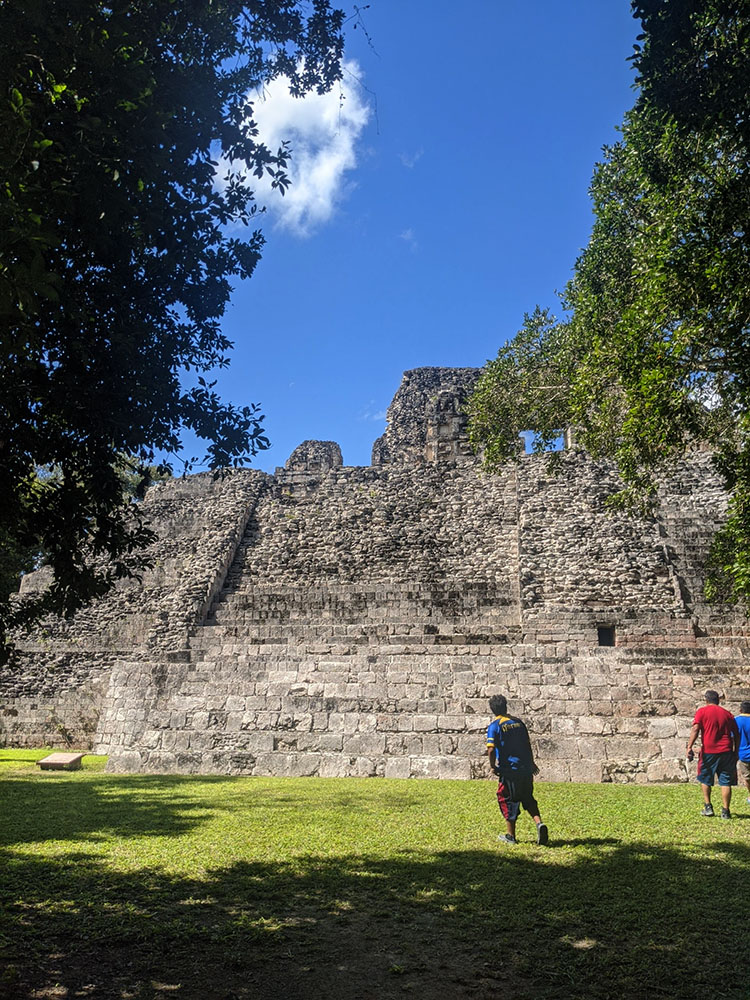

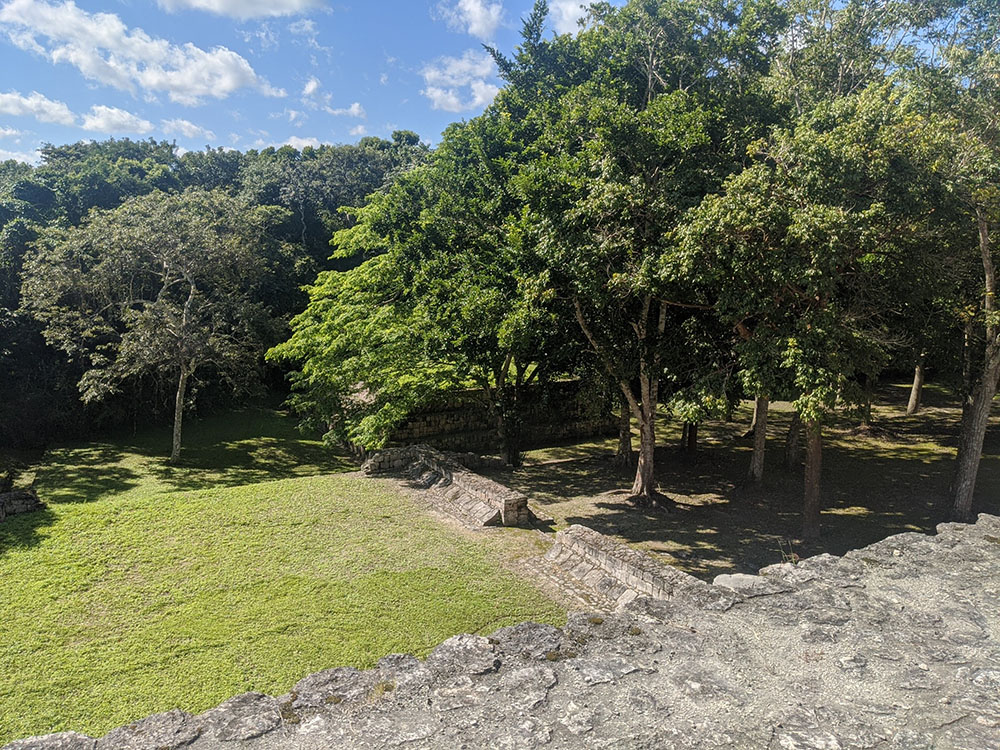
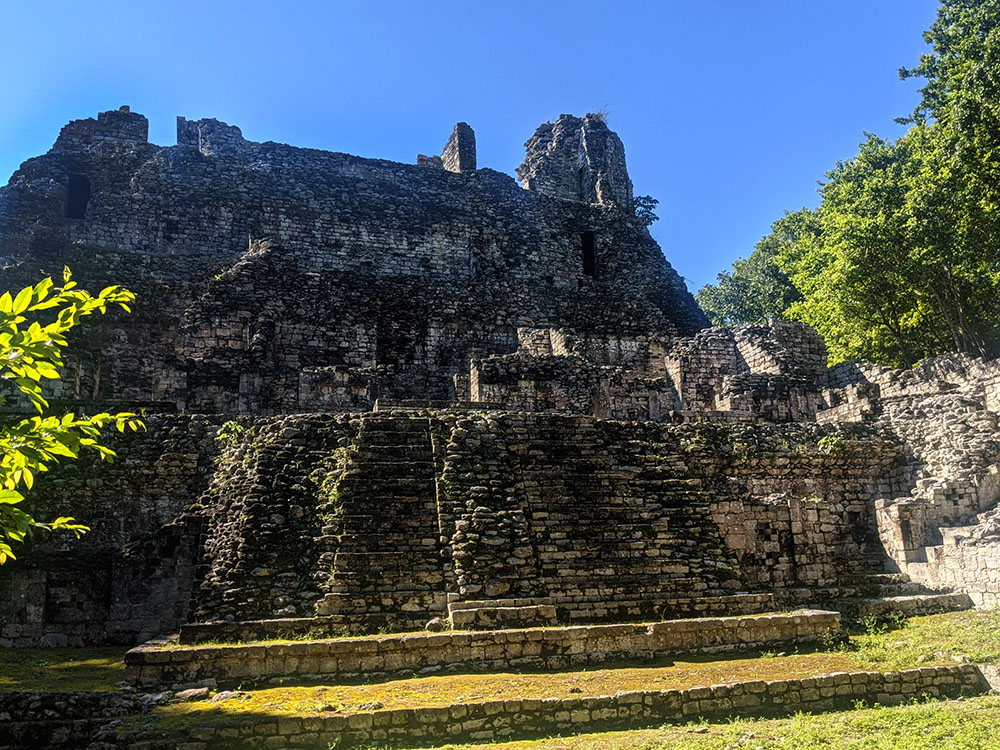

Below is all that’s said about building 9 which is a bizarre sign and clearly misleading as I would discover later.
“This building is the tallest in Becan reaching a height of approximately 32 metres above the plaza. It contains the remains of an enormous stairway which provides access to a temple built in the upper part. We would appreciate you not climbing it in order to prevent accidents as well as to preserve the archaeological materials in their original location”

So as to building number 9, I didn’t know at the time that this was the place that the day after his memorial service a tomb was discovered, if I had known I would have said a little prayer to Piña Chan . It just shows how neglected the signs are that they don’t even commemorate one of their famous pioneers in archaeology, or indeed that a tomb was discovered in one of the buildings. Shame on them and their kowtowing to the travel guides who probably don’t even mention these interesting facts as opposed to the guides mostly fabricated fairy tales.

Temples were erected on the top of some of these very high structures and representations of Itzamna the creator god known also as the Earth Monster. The whole site is highly decorated and a lot of the terracotta paint is still visible in a pinky hue. I was in seventh heaven so diverse were all the nooks and crannies. Lattice works, temples and many sheer drops especially overlooking the plaza reminds you of the near fatal accident that left Piña Chan paralysed and in bed for the rest of his life. I must say I could easily have stepped back a few time to admire something and fallen to my death.


 Old Bird Travels Solo!