

OR DAYS OUT IN LONDON. ART AND NATURE.
Kew is always a must-go venue when it’s going to be boiling hot, so when my mate invited me the other day I jumped at the chance. What could be better than a picnic and wander around at these venerable gardens on a hot July day?
Although I woke a little late, I still managed to scramble and fixed myself a flask of iced coffee, boiled a couple of eggs and made a pita and cheese sandwich with bits of cucumber poking out in this rather crude fare. I also whizzed up a smoothie and put filtered water in my copper flask to rehydrate during the course of the day. The day was glorious and I wasn’t in a moany mood so I went straight into the gallery to check out the amazing new exhibition which indeed was amazing.

Daniel, my British Museum pal, who has been saving my sanity while I wait on Turkiye and the various disasters that have mercilessly struck me, was quietly insistent about the order of the day’s itinerary. He was spot on as I was to find out by the end of this hot sunny day.
Strolling down the sunlit-dappled path, we arrived at the gallery before the hordes arrived. It was worth it, a beautiful show awaited.
Shirley Sherwood Gallery of Botanical Art

About the gallery: ‘The Sherwood family have generously supported New with the building of the Shirey Sherwood Gallery of Botanical Art. Use only purpose-designed botanical art gallery in the wild. The gallery was opened in April 2008 and by 2022 was visited by over a million visitors. in recent years the gallery has broadened the scope of its exhibitions by featuring some of the world’s innovative and exciting contemporary art by artists who work with or are inspired by our collections highlighting themes of biodiversity and climate change.’
The walkthrough was impressive with two new exhibits as you enter.
The importance of botanical art. Sue Wickison.
‘The artistic depiction of plants has an ancient history and was originally used as a means of identification. By the end of the Renaissance, botanical painting had become appreciated as an art form in its own right.


Botanical art is unique in bringing together scientific accuracy and artistic sensibility. True practitioners are highly skilled in both aspects. They also have to overcome problems specific to this kind of work, such as drawing from flattened and dried as well as live specimens and capturing the colour of a flower before it fades. The perseverance required frequently results In drawings and paintings which are not only beautiful and keenly observed, but also inspirational
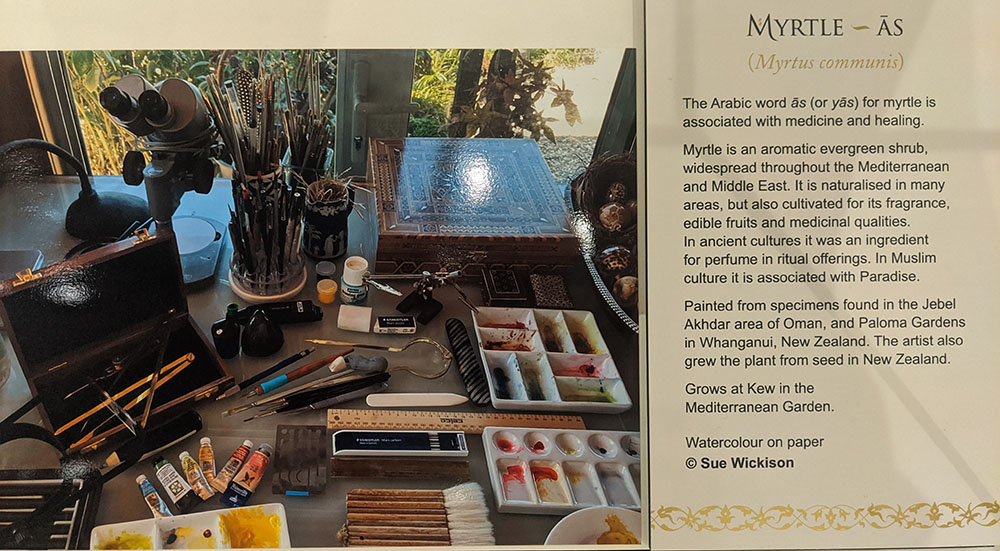
Today, botanical art serves an additional purpose-highlighting the beauty and diversity of the plant world, it is used in books and other publications where strong images of rare and endangered plants can help to communicate the vital message of conservation

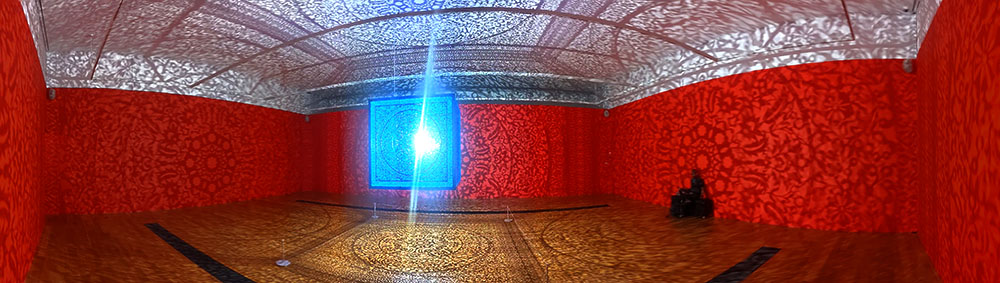
Apart from the amazing light show of the relatively simple concept of creating metal sculptures that reflect the light and shadows on surrounding or opposite walls, there is a selection of beautifully painted watercolours to tie in with these exotic light shows.’
PARADISE GARDENS.
There is a long tradition in the Islamic world of creating gardens. They are often designed as reflections of the heavenly realms described in the Qur’an. Known as ‘paradise gardens, they incorporate elements of shade and water within an enclosed space. These features held significance, having emerged from a desert landscape where such elements would be invaluable. Enclosed private spaces have also traditionally provided safe places for women to gather and socialise.
The Qur’an states that human beings have been chosen as ‘stewards’ of the earth and that we have a duty to manage and care for our environment. Many Islamic gardens have sustainability and biodiversity conservation at their heart, together with great aesthetic beauty.
POMEGRANATE. RUMMAN

In the Qur’an, rumman or pomegranate is seen as a blessing, a symbol of Paradise, and an illustration of the importance of not being excessive or wasteful.
Pomegranate is now cultivated in many parts of the world, but Iran and Central Asia remain as the main producers, where it forms an integral part of their cuisine. The pomegranate has long been a celebrated fruit in many different cultures, a symbol of fertility, prosperity, righteousness and eternal life.
Painted from specimens found in the Jebel Akhdar area of Oman, and Dubai, UAE.
Lacquered steel and LED bulb 2017
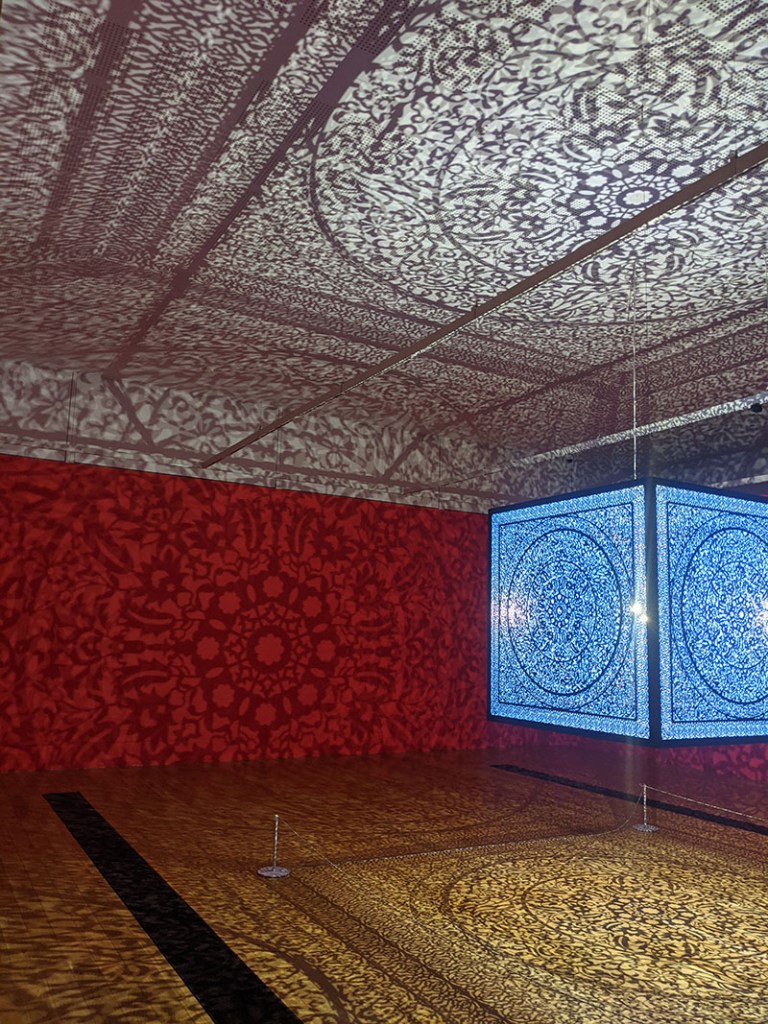
Often, my goal is to explore the binaries of public and private, light and shadow, and static and dynamic, by relying on the purity and inner symmetry of geometric design, and the interpretation of the cast shadows in both the sculptural installations and the flatwork”
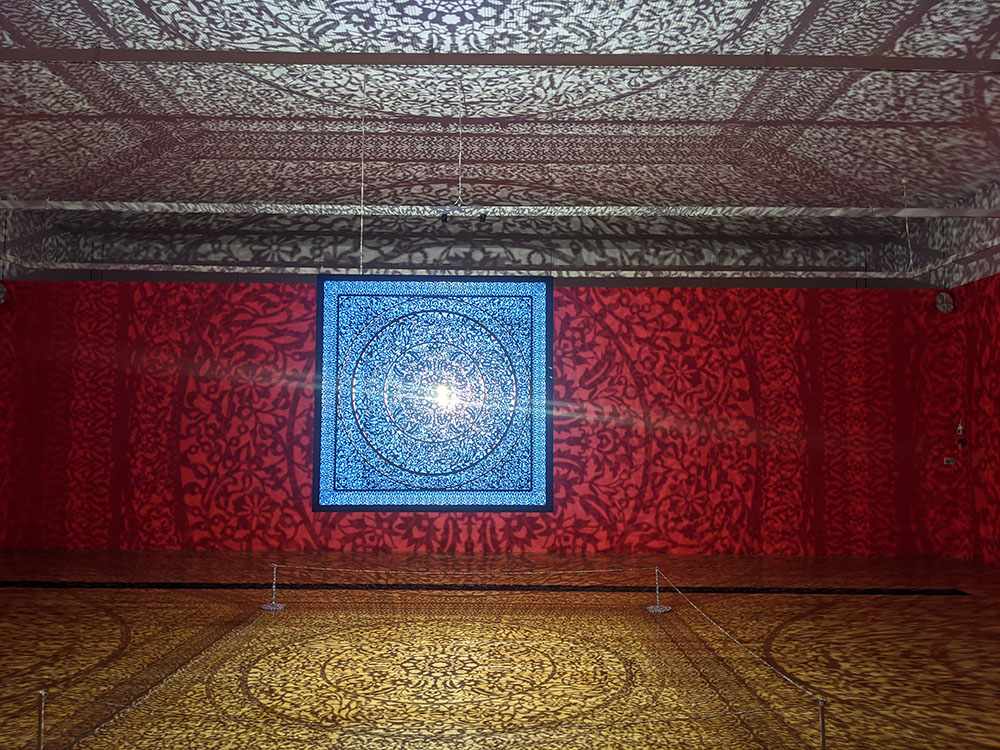
‘Suspended from within, this intricately detailed floating steel cube casts elaborate floor-to-ceiling shadows that transform the surrounding gallery space. The work alludes to the richly ornamented public spaces, such as mosques, that Agha was excluded from as a female growing up in Lahore due to cultural norms.’

‘Inspired by South and Central Asian Islamic architectural forms, with geometric and floral designs, the installation uses light, and action within a large space. The presence of tors is integral in experiencing a shared space, to Intunecally contemplate intimacy along with the differences that shape our lives and relationships.’
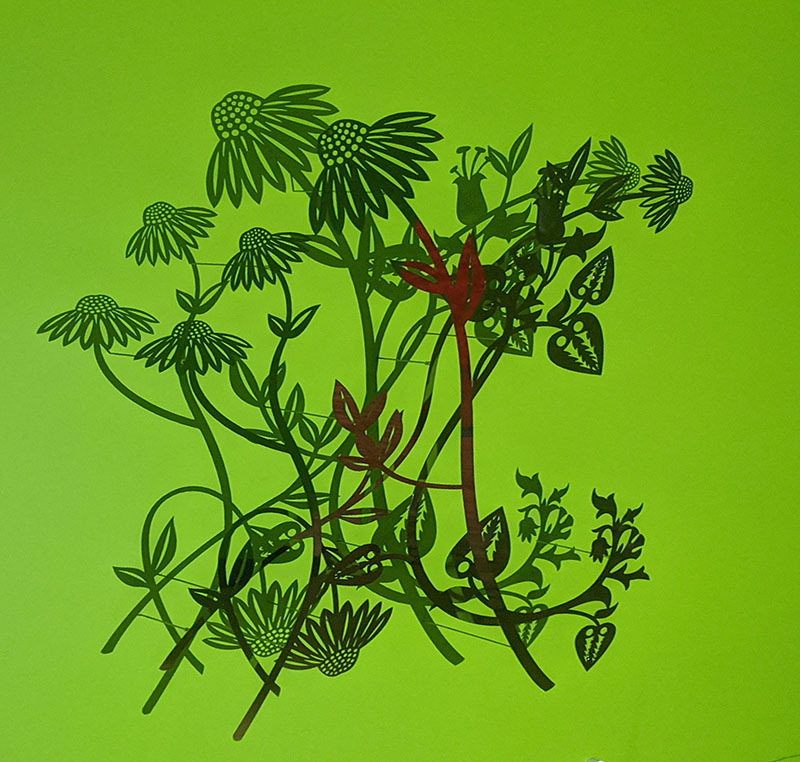
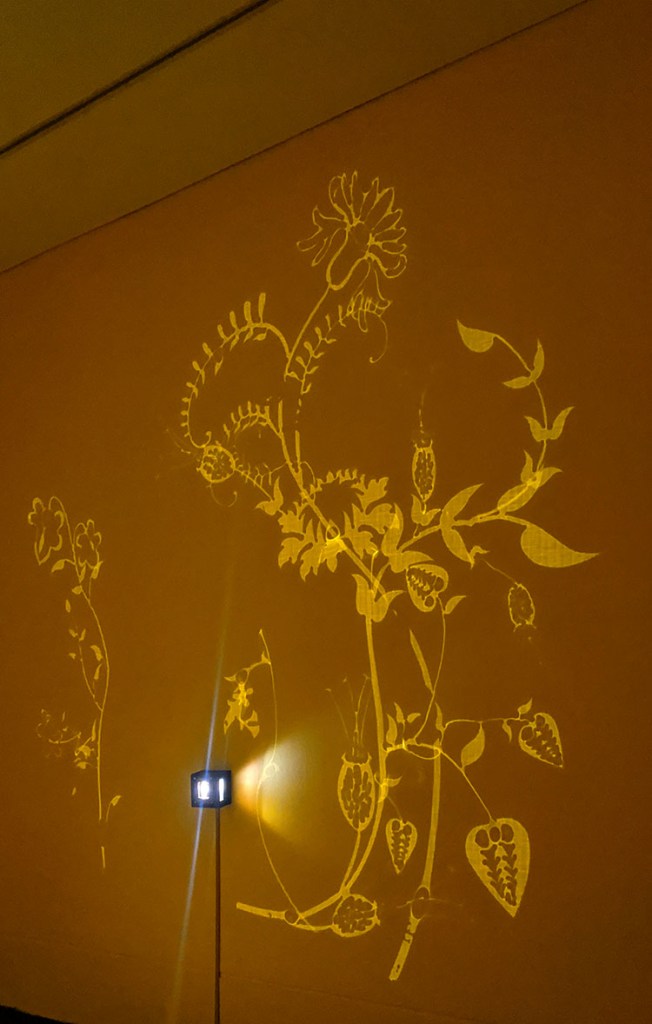
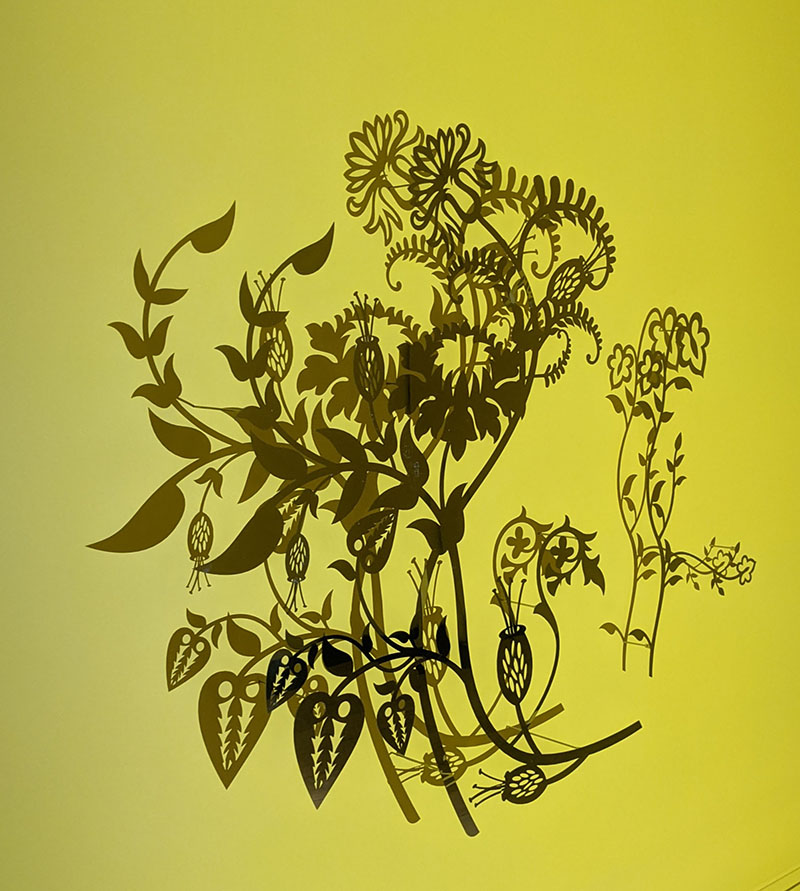
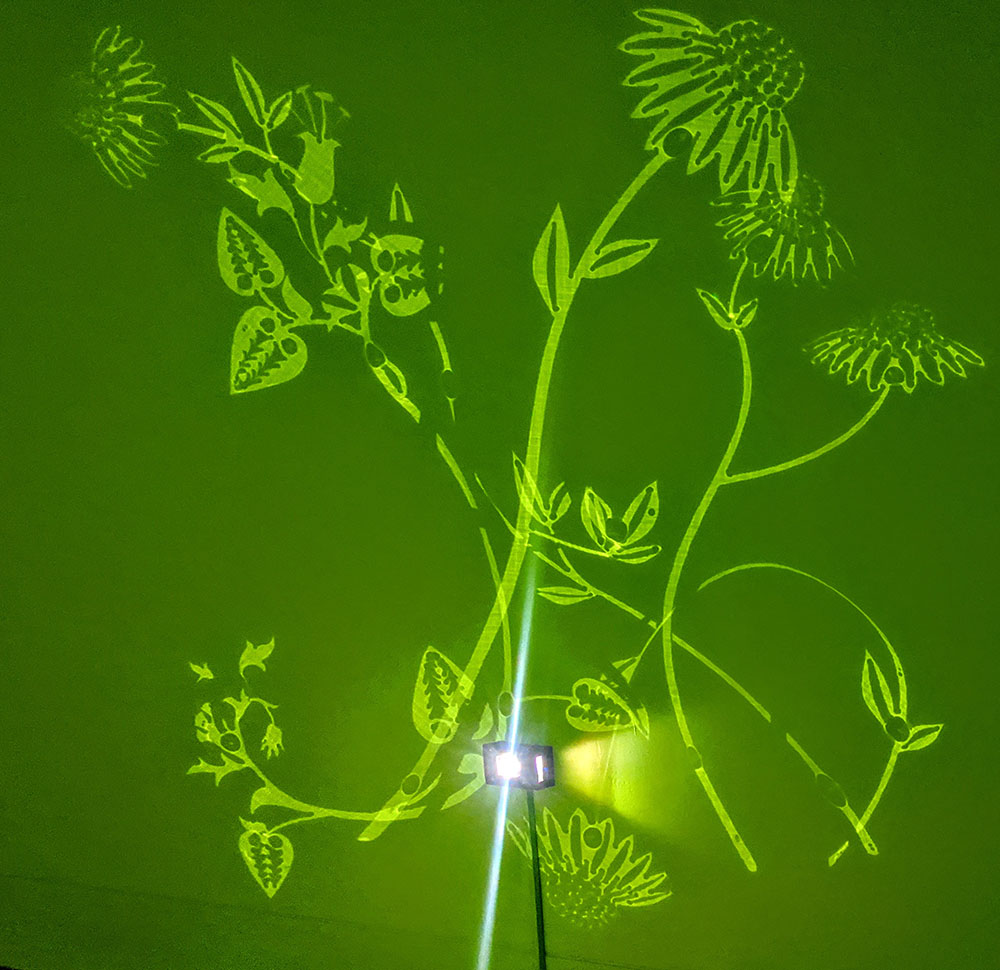
‘These wall-mounted steel bouquets and flora-shaped shadows that flutter on the wall are a metaphor for the tangled complexities of contemporary life. Formed from an earlier work entitled Stealing Beauty, which was inspired by Great Piece of Turf, a detailed watercolour study of grasses and wildflowers created in 1503 by the German Renaissance artist Albrecht Durer, this artwork explores ideas about cultural appropriation.’
‘The mirrored, stainless steel wall reliefs are laser-cut with sinuous floral patterns, comprising visual elements from South Asian Islamic culture enmeshed with motifs by the 19th-century British textile designer William Morris. who himself was inspired by Islamic art and architecture that he encountered in his travels. In reimagining these patterns, Agha considers questions about inspiration versus appropriation, and how we often value or legitimise art based on who created it.’
These exhibits are well worth a visit and have inspired me to try to recreate both the lighting and some painting. Indeed it reminded me that I really need to be back in Turkiye to start on my natural botanical fabric dying.
Lucy Smith, WATERLILIES.
‘Lucy T Smith-working sketches Here is a selection of some original drawings, colour studies and observations that botanical artist Lucy Smith made during the investigation of a new giant waterlily species, along with some materials. They include initial drawings for the Victoria cruziana second-night flower watercolour painting, and the life-sized Victoria amazonica leaf underside painting, both on show in this gallery, as well as drawings for Victoria boliviana. You can see the Victoria waterlilies growing in the Princess of Wales Conservatory and the Waterlily House here at Kew from March until November.

In 2016, Lucy began a project to illustrate the two known species of giant waterlily, Victoria amazonica and Victoria cruziana. She wanted to use the scientific botanical illustration skills she had honed working as a freelance botanical artist for Kew since 1999. This involved observation and examination of the waterlilies flowers, which on open over two nights and change dramatically in and between. To do this, Lucy spent many late nights in Kew’s glasshouses, waiting for flowers to open capturing before they closed again or sank underwater.

‘Along the way, she began working with Kew’s scientific waterlily expert Carlos Magdalena to document and des a third, new species of giant waterlily. This species was grown in Kew in 2018, from seed given to Carlos by the Santa Cruz de Sierra Botanical Garden in Bolivia for investigation as a possible new taxon. Lucy’s observations of all three species for illustration ped formulate scientific descriptions of them in a species delimita paper, which included the designation of the new species, Victa boliviana, published in 2022.’
“My work as a botanical artist for Kew has trained me to identify and depict the differences between plant species… I was excited to take this one step further by not only illustrating the existing and new species but also being a lead author of the academic paper setting out the case for the new species. I hope that the illustrations will help others identify all three species of the giant Victoria waterlilies for years to come.” Lucy T Smith’ All quite above are from their info!
Walking in the Gardens
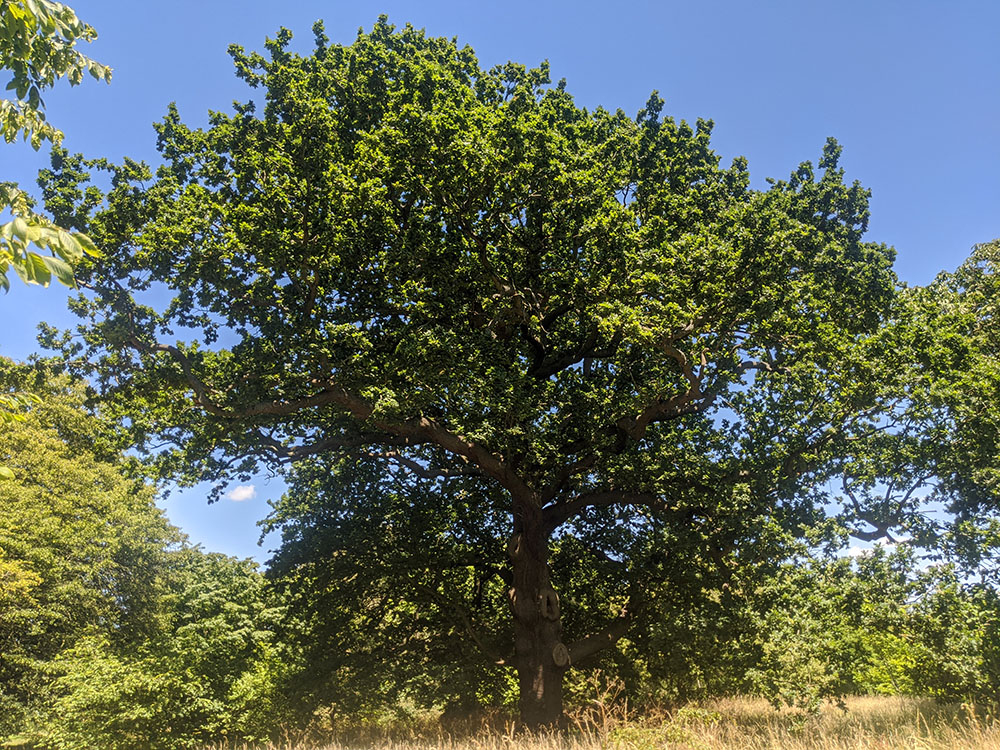
After the cool of the gallery, we walked out into the hot sun that beat upon us relentlessly. Daniel was getting peckish so we went to his favourite quiet place near the Japanese house. There I set about checking out the proper names of the surrounding oaks. Who knew there were so many varieties? I started my mission then, learning how to identify the different trees by their leaf shapes and trunk textures. It was great trotting around to finally identify trees I hadn’t known at all. With the names on each tree, it was a very rewarding task. Daniel sent me off on missions to check out tree names which I did like a good doggy. I think he was glad to have a break from my fidgety ways. I always get over-excited on a mission!


Diving into my iced coffee and polishing off a hard-boiled egg I requested we move to a new spot, he had finished his pasta salad and was happy to amble on. As Daniel and I are both used to organising our own days out it was nice to turn myself over to somebody else’s plans, so with that in mind he outlined the walk and included my favourites. You see a solo old bird can cooperate!

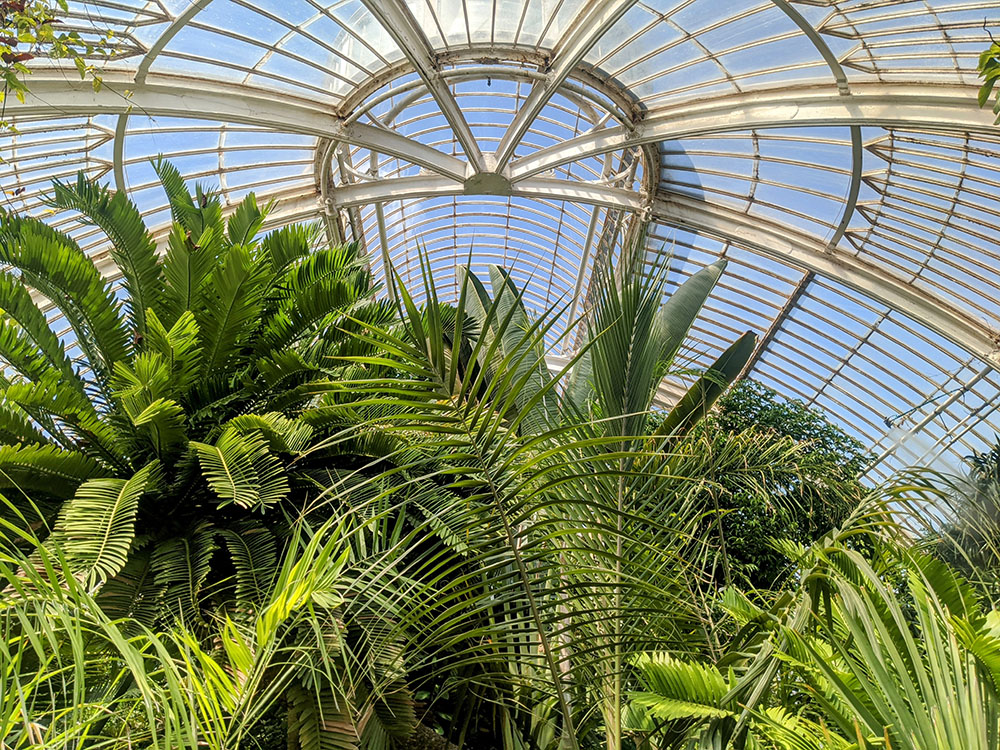
We walked to my favourite, the Mediterranean Garden with its huge rocks and red earth, which felt more than authentic in the furnace-like heat and sun. The follies had people in so we walked on to the palm and waterlily houses and then through the rose walkway the roses still smelled divine) and to my favourite veggie patches that I sniffed haughtily at. My stuff on the terrace is doing better without me even trying this year.

I was happy in my bare feet ‘earthing’ or ‘grounding’ myself and at one with nature albeit a refined version. I felt better than I had in days. The dark dog had lifted from my shoulders and the negative ions from the earth had done their job and re-energised me. I felt brand new!
We hung out in the walled garden to rest before tackling the vile journey back. I read my book lolling on the grass after having refused to ‘read aloud’ for my pal. What a cheek!


It’s always a terrible effort to leave and go back to an awful muggy. over-crowded city centre after a day out so perfect. See you Kew and cheers Daniel, you’re a life-saver, my friend x

 Old Bird Travels Solo!